
How Much Does a 30-Day India Trip Really Cost?

 https://images.prismic.io/natouris/aX2fFN0YXLCxVOtf_HowMuchDoesa30-DayIndiaTripReallyCostThumbnail.webp?auto=format,compress&rect=0,96,800,420&w=1200&h=630
The Real Talk About India's Travel Costs (And Why Everyone Gets It Wrong)
Let me guess. You've been scrolling through Instagram, watching backpackers live like royalty on seemingly pocket change in India, and you're wondering if those ₹30-per-day claims are actually legit. Or maybe you've heard horror stories about hidden costs and tourist traps that'll drain your wallet faster than you can say "namaste."
Here's the thing: India is simultaneously one of the cheapest and most confusing countries to budget for. I've seen travelers blow through $2,000 in a month while others stretch $600 to cover the same timeframe. The difference? Knowing exactly where your money goes.
So let's cut through the noise. This isn't some cookie-cutter budget guide that pretends everyone travels the same way. Whether you're a hostel-hopping backpacker who lives for ₹50 thalis or someone who needs AC and a decent mattress to function, I've got the breakdown you actually need.
The Three-Tier Budget Reality: Pick Your Adventure
Before we dive into the nitty-gritty numbers, you need to understand something crucial. India doesn't have one price tag. It has three completely different budget tiers, and mixing them up is where most travelers go wrong.
Budget Backpacker: The ₹1,000–1,500/Day Hustle ($12–18 USD)
This is bare-bones India. You're sleeping in fan rooms (forget AC), eating where locals eat, and treating every rupee like it matters. Can you travel India for a month on $500 to $700? Absolutely, but you'll be making sacrifices.
Mid-Range Wanderer: The ₹2,500–4,000/Day Sweet Spot ($30–48 USD)
This is where most people land, and honestly? It's the goldilocks zone. You get private rooms with AC, the occasional Uber instead of sweating on buses, and the freedom to splurge on that cooking class without calculator anxiety.
Comfortable Explorer: The ₹5,000+/Day Experience ($60+ USD)
Think boutique hotels, domestic flights between cities, and restaurants with English menus. You're looking at $1,800+ for the month, but you're also preserving your sanity and energy.
Breaking Down the Daily Budget for India Trip: Where Every Rupee Goes
Let me show you exactly what each tier looks like when you zoom in. Because "daily budget" sounds simple until you realize accommodation costs the same whether you sleep 8 hours or 16.
Accommodation: Your Biggest Variable (And Biggest Opportunity to Save)
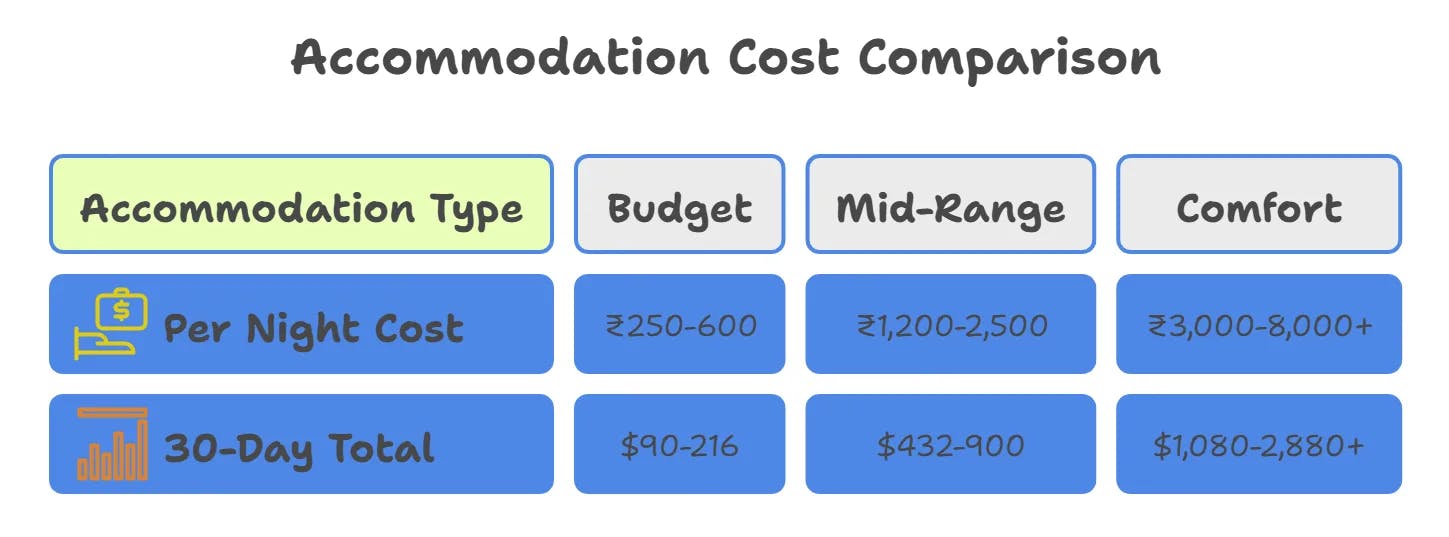
Budget Backpacker ($3-8/night): Hostel dorms are your best friend here. Cities like Delhi, Jaipur, and Goa have killer hostels for ₹300-600 per night. In smaller towns? I've scored clean guesthouses for ₹250. Pro tip: Hostels often throw in breakfast, which immediately shaves ₹100-150 off your food budget.
Mid-Range ($15-30/night): This gets you private rooms with attached bathrooms, AC, and Wi-Fi that actually works. Think ₹1,200-2,500 depending on the city. Mumbai and Goa will push you toward that upper limit; Varanasi and Pushkar keep you comfortably lower.
Comfort Zone ($35-100+/night): Heritage hotels, boutique properties, and places where the shower is hot without a 20-minute wait. You're looking at ₹3,000-8,000+.
Food Costs Per Day in India: From Street Stalls to Rooftop Restaurants
Here's where India really shines. You can eat like a king without royal spending.
Budget Eating (₹150-300/day, $2-4): Street food breakfast (₹40), local thali for lunch (₹60-80), street food dinner (₹50-70), plus chai breaks (₹10 each). You'll eat well, but you're sticking to Indian food almost exclusively. That month-end total? Just $60-120 for all your meals.
Mid-Range Food Game (₹400-700/day, $5-8): Mix of local spots and tourist-friendly restaurants. Breakfast at a café (₹150), lunch at a decent restaurant (₹200-300), dinner with variety (₹250-350). Add in the occasional Western food craving, fresh juice stops, and you're golden. Monthly: $150-240.
Comfort Dining (₹800-1,500+/day, $10-18+): Hotel breakfasts, AC restaurants, Western food whenever the mood strikes. You're not checking prices before ordering. Monthly: $300-540+.
Transportation Costs: Trains, Buses, and the Occasional Sanity-Saving Flight
This is where your India trip budget for 30 days gets interesting. India's trains are legendary cheap, but they're also chaotic.
Budget Transport (₹200-400/day, $2.50-5): Second-class sleeper trains, local buses, metro in cities, and a whole lot of walking. For a 30-day India itinerary covering North India highlights (Delhi-Agra-Jaipur-Varanasi-Rishikesh loop), you might spend ₹6,000-12,000 total ($72-144).
Mid-Range Movement (₹400-800/day, $5-10): Third AC trains, semi-sleeper buses, occasional Uber/Ola in cities. You're comfortable but not wasteful. Monthly: $150-300.
Comfort Travel (₹1,000-3,000+/day, $12-36+): AC buses, Second AC trains, domestic flights between major cities, and app-based rides instead of haggling with auto-rickshaws. Monthly: $360-1,080+.
Real Talk: That one Delhi-to-Goa flight (₹3,000-6,000) can blow a week's budget transport budget, but it also saves you 36 hours of travel time. Sometimes comfort wins.
Activities and Entrance Fees: The Hidden Costs Nobody Warns You About
India's monuments are cheap. But those activities add up fast.
- Taj Mahal: ₹1,100 (foreigners)
- Red Fort, Delhi: ₹600
- Amber Fort, Jaipur: ₹500
- Cooking class: ₹1,500-3,000
- Yoga retreat (weekly): ₹5,000-15,000
- Scuba diving, Andaman Islands: ₹4,000-6,000
- Desert safari, Rajasthan: ₹1,500-3,000
Budget tip: Most temples are free. Nature is free. Walking tours are often free (tip-based). You can easily spend ₹0-200/day on activities if you're selective. But if you want the full experience? Budget ₹500-1,000/day minimum.
Regional Price Variations: How Your India Travel Budget Changes by Location
Not all India is created equal, budget-wise. Let me break down what I've learned bouncing between regions.
North India One Month Budget: The Golden Triangle and Beyond
Delhi-Agra-Jaipur is tourist-heavy, which means slightly inflated prices but better budget infrastructure. Daily costs: ₹1,200-1,800 for budget travelers, ₹2,500-4,000 for mid-range.
Himachal Pradesh and Uttarakhand: Mountain magic is surprisingly affordable. Dharamshala, Rishikesh, and Manali have great hostels (₹300-500) and cheap local food. Budget ₹1,000-1,500/day comfortably.
South India 4-Week Trip Cost: The Cheaper, Chiller Alternative
Kerala, Karnataka, Tamil Nadu. They're slightly less touristy (except Goa), which means better local prices. Plus, thalis are bigger and cheaper. I've done comfortable South India travel on ₹1,800-2,200/day including decent accommodation.
Goa Exception: Beach season Goa (November-March) is pricey. Accommodation jumps 2-3x. Off-season? You'll find ₹500 rooms easily.
The Mumbai-Bangalore Premium
Metropolitan India costs more. Period. Budget an extra 30-50% for accommodation and food in these cities. That ₹600 hostel in Jaipur? It's ₹1,000 in Mumbai.
The Complete 30-Day India Budget Breakdown: Three Real Scenarios
Let me show you what actual month-long budgets look like, soup to nuts.
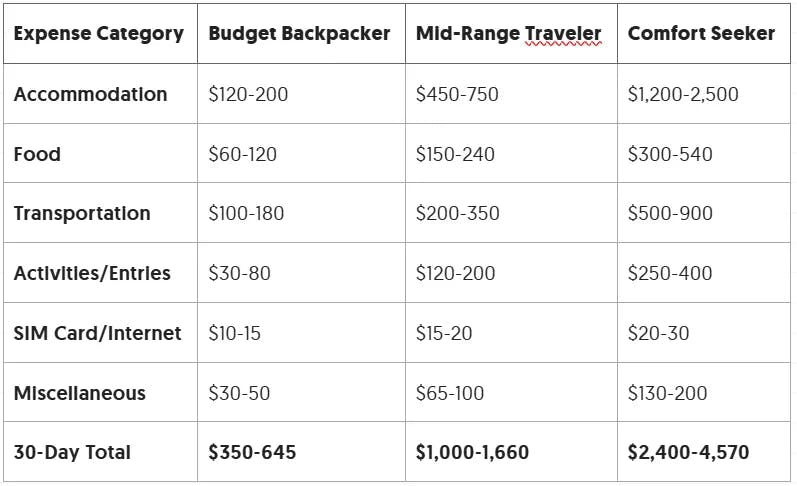
Note: These don't include visa costs (₹5,300-7,500 for most nationalities) or travel insurance ($30-100/month).
Is India Still Cheap for Backpackers in 2025-2026? The Honest Answer
Yes, but less than it used to be. Inflation happens everywhere, and India's tourism infrastructure is upgrading. That said, India remains one of the best value destinations globally.
What's Changed:
- Hostels that were ₹200 in 2019 are ₹400-500 now
- Street food has crept up ₹10-20 per item
- Uber/Ola prices increased slightly
- Popular tourist sites (Taj Mahal, etc.) raised foreigner fees
What Hasn't:
- Local restaurants are still incredibly cheap
- Train travel remains absurdly affordable
- You can still find ₹300 guesthouses in smaller towns
- Temples, beaches, and hiking are free
Bottom Line: Can you still travel India on $30 a day? Barely, in budget areas during off-season. Is $40-50/day more realistic for comfortable budget travel? Absolutely.
Money-Saving Tips That Actually Work (Tested by Broke Backpackers)
Let me share the strategies that have saved me (and countless travelers I've met) serious cash.
1. Travel During Shoulder Season (February-March, September-October) Accommodation prices drop 30-50%. You skip both monsoon chaos and peak-season premiums.
2. Book Trains Early Tatkal (last-minute) tickets cost more and sell out. Book 30-60 days ahead for best prices and availability.
3. Eat Thalis for Lunch Unlimited refills. ₹60-100 gets you stuffed. That's basically two meals' worth of food for one price.
4. Stay Longer in Each Place Constantly moving means constantly paying for transport. Stay 4-5 days minimum per destination and negotiate weekly accommodation rates (usually 10-20% off).
5. Use Local SIM Cards for Everything Airtel or Jio: ₹600-800 for unlimited data for a month. This means Google Maps, WhatsApp, and skipping expensive Wi-Fi cafes.
6. Learn Basic Hindi Numbers You'll immediately get local prices instead of tourist prices. "Kitna?" (How much?) is your new best friend.
Hidden Costs When Traveling India for a Month (And How to Plan for Them)
Here's what catches people off-guard:
Visa: ₹5,300-7,500 depending on your nationality. E-visa is cheapest.
Travel Insurance: $30-100/month. Non-negotiable. India's roads are chaotic and one hospital visit without insurance can cost more than your entire trip.
Laundry: ₹30-50 per kg. Budget ₹100-150/week if not washing by hand.
Toilet Paper: Not standard in budget accommodations. ₹30-50 per roll adds up.
Water: ₹20-40/day for bottled water (please use a filter instead).
ATM Fees: International cards get hit with ₹200-300 per withdrawal. Withdraw big amounts less frequently.
"Tourist Price" Tax: That auto-rickshaw ride that locals pay ₹40 for? You'll pay ₹100 until you learn to negotiate.
Total Hidden Costs: Budget an extra $100-200 for the month to cover these surprise expenses.
Can I Travel India for One Month on $500-700? The Brutally Honest Answer
Short answer: Yes, but you'll work for it.
I've met travelers who've done it. Here's their recipe:
- Couchsurfing and ultra-budget guesthouses (₹200-300/night)
- Eating 90% street food and local dhabas
- Second-class sleeper trains exclusively
- Free activities only (temples, beaches, hiking)
- Staying in tier-2/3 cities, avoiding Mumbai/Delhi/Goa
- Zero alcohol, limited coffee shops, no shopping
Is it sustainable for 30 days? Depends on your tolerance for discomfort and your ability to embrace chaos.
More realistic budget for comfortable budget travel: $800-1,200. This gives you breathing room for the occasional AC room, a few nice meals, and activities that actually enhance your experience.
Your India Travel Budget Checklist: Getting Ready to Go
Before you book that flight, make sure you've budgeted for:
✓ Visa fees ($80-100)
✓ Travel insurance ($30-100/month)
✓ Vaccinations (if needed, $50-200 before trip)
✓ Emergency fund (extra $200-300)
✓ Flight buffer (prices to India from US/Europe: $500-1,200 depending on season)
✓ Pre-trip gear (backpack, water filter, etc. if needed)
Pro move: Carry a mix of cash USD/EUR/GBP (for good exchange rates), one debit card, and one credit card. Never keep them in the same place.
Final Thoughts: What's Your One Month India Travel Budget Sweet Spot?
Here's what I've learned after watching hundreds of travelers (and making my own budget mistakes): The magic number for most people is $1,200-1,500 for 30 days in India, including everything except flights.
This gives you comfort without waste, experiences without FOMO, and enough buffer to handle India's beautiful unpredictability. You'll sleep in clean rooms, eat adventurously without gut issues, and say "yes" to that sunrise camel safari without calculator anxiety.
Could you do it cheaper? Sure. Will you enjoy it more with a bit of financial breathing room? Absolutely.
India doesn't need to break the bank. But it also shouldn't break your spirit because you're stressing over every ₹50. Find your sweet spot, build in buffer, and get ready for the most intense, colorful, delicious, chaotic month of your life.
Ready to start planning? Take this budget breakdown, adjust it to your travel style, and book that ticket. India's waiting and trust me, it's going to be worth every single rupee.
Share this article