
How Public Transport Works Across Asia's Biggest Cities: Your Complete Guide

 https://images.prismic.io/natouris/aXy0CgIvOtkhCHod_HowPublicTransportWorksAcrossAsiasBiggestCitiesYourCompleteGuideThumbnail.webp?auto=format,compress&rect=0,4,800,420&w=1200&h=630
Here's something I learned the hard way: if you can master public transport in Asia's biggest cities, you can navigate anywhere on Earth. Period.
I still remember my first morning in Tokyo, standing paralyzed at Shinjuku Station while approximately three million commuters flowed around me like water around a confused rock. The metro map looked like someone had thrown spaghetti at a wall and called it infrastructure. But here's the beautiful paradox: what seemed impossibly complex at 7 AM became elegantly intuitive by noon.
That's Asia's public transport in a nutshell. It's simultaneously the most intimidating and most brilliant transportation ecosystem humanity has ever built. And once you crack the code? You'll wonder why the rest of the world hasn't caught up.
The Big Picture: How Asian Cities Move People
Let's cut through the romance and talk mechanics. Public transport in Asia operates on a fundamentally different philosophy than what you'd find in Los Angeles or even London. These systems weren't designed as afterthoughts or add-ons. In cities like Singapore, Hong Kong, and Tokyo, public transit IS the backbone. It's not how some people get around. It's how everyone gets around.
The typical Asian cities public transportation network combines several layers:
The Heavy Hitters: Metro and MRT systems that move millions daily with Swiss-watch precision. These aren't your grandmother's subways. We're talking trains arriving every 90 seconds during rush hour, platform doors that sync perfectly with train doors, and departure times you could literally set your watch by.
The Ground Game: Comprehensive bus networks that fill the gaps metros can't reach. In cities like Seoul, buses are color-coded by route type (blue for long-distance, green for local, red for express). Simple, brilliant, effective.
The Rapid Solutions: Bus Rapid Transit (BRT) systems that combine the flexibility of buses with metro-like efficiency. Jakarta's TransJakarta and Bangkok's BRT corridors prove you don't always need billions for underground tunnels to move people fast.
The Last-Mile Magic: Here's where Asia gets creative. Tuk-tuks in Bangkok, jeepneys in Manila, angkot minibuses in Indonesia, songthaews in Thailand. These informal paratransit services are the duct tape holding everything together, and honestly? They're often the most fun part of the journey.
The Champions: Which Cities Actually Get It Right?
You want rankings? Fine. But understand that "best" depends on what you value.
Tokyo takes the crown for sheer operational excellence. The metro and MRT systems in Asia don't get more sophisticated than this. We're talking 13 metro lines, over 280 stations, and an on-time performance rate that hovers around 99.9%. Yes, you read that right. When a Japanese train is late by two minutes, it makes national news. The integration between JR lines, private railways, and metro services is so seamless that 40 million trips happen daily across the Greater Tokyo Area without anyone breaking a sweat.
Singapore wins on simplicity and integration. The MRT network might be smaller, but every station connects logically to bus terminals, and the entire system works on a single contactless card. The government deliberately designed neighborhoods around transit nodes, so you're never more than a ten-minute walk from a station. That's not luck. That's urban planning as an art form.
Hong Kong perfected the business model. The MTR doesn't just move people; it's a real estate empire that develops properties around stations. The revenue from those developments subsidizes affordable fares. Genius, right? Plus, the integration between metro, buses, trams, and ferries means you can explore the entire city without ever touching a car.
Seoul brought democracy to data. Real-time bus tracking, multilingual apps, and integration that lets you transfer between subway and bus within 30 minutes using the same fare. The T-money card works everywhere, from transit to convenience stores.
The Nitty-Gritty: How You Actually Pay and Navigate
Let's talk smart ticketing and cashless payment systems in Asian public transport, because this is where the magic happens.
Gone are the days of fumbling with coins. Most major Asian cities now operate on three payment ecosystems:
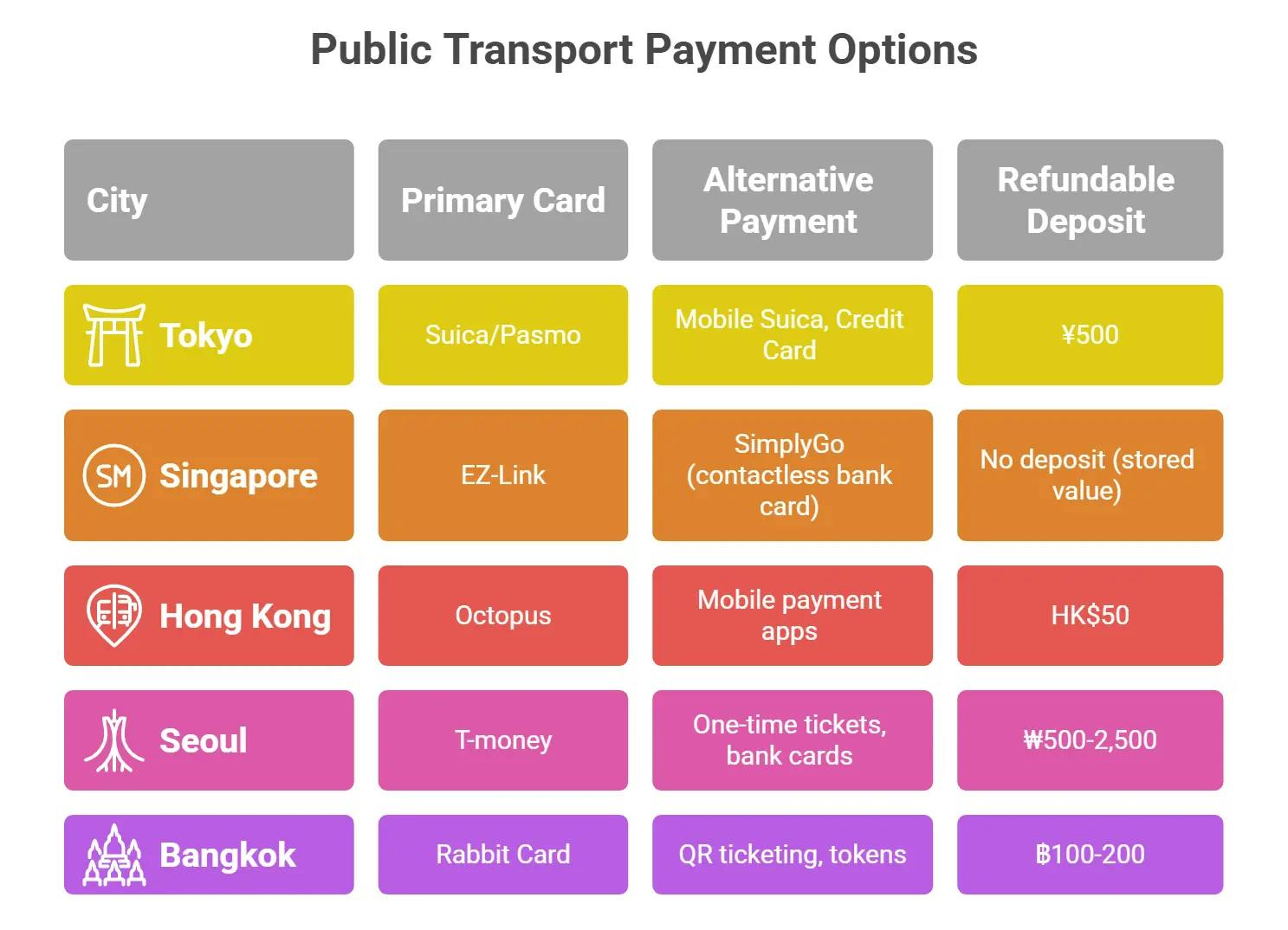
Smart Cards: Singapore's EZ-Link, Hong Kong's Octopus, Tokyo's Suica and Pasmo, Seoul's T-money. These aren't just transit cards they're lifestyle tools. Tap on, tap off, done. Many work across multiple cities too. I've used my Suica in Tokyo convenience stores, vending machines, and even some restaurants.
QR Codes: Bangkok, Jakarta, and increasingly Chinese cities favor QR-based mobile payments. Download the app, load credit, scan the code at entry and exit. The learning curve is slightly steeper, but the flexibility is unmatched.
Mobile Integration: Seoul and Singapore let you use credit cards or phones directly at gates. No separate card needed. Just tap your contactless Visa or Apple Pay and go.
Here's the insider move: get a rechargeable smart card on day one of your trip. The time you save not queuing for single-journey tickets will pay for itself by lunch.
The Integration Question: Does Everything Actually Connect?
Short answer: it depends where you are.
Public transit integration in Asia ranges from "absolutely flawless" to "gloriously chaotic improvisation."
Singapore and Hong Kong represent the gold standard. Transfer from MRT to bus? Your second ride is discounted if made within the transfer window. The physical infrastructure connects too major stations have bus interchanges built directly above or below them. You don't brave the elements to change modes.
Tokyo's integration is technically brilliant but practically confusing. Yes, everything connects. But you've got competing private railway companies, each with their own fare systems, meaning your journey might cross three different operators requiring three separate calculations. The technology works perfectly; the bureaucracy less so.
Bangkok and Jakarta show us the work-in-progress model. The BTS Skytrain, MRT, and Airport Link technically integrate through stored-value cards, but you'll often need to exit one system completely and walk to another. The bus and BRT systems in Asian cities like Bangkok run parallel rather than integrated networks, which means planning trips requires consulting multiple apps.
Then there's the informal public transport in Asian cities layer. Those paratransit services minibuses, tuk-tuks, jeepneys, angkot rarely integrate officially with formal systems. But they solve the last-mile connectivity puzzle that billion-dollar metro systems can't. In Jakarta, you'll take the TransJakarta BRT to a major stop, then grab an angkot minibus for the final kilometer to your actual destination. Is it on Google Maps? Maybe. Does it work? Absolutely.
The Money Talk: What Does All This Actually Cost?
Here's where Asia will spoil you forever for Western transit.
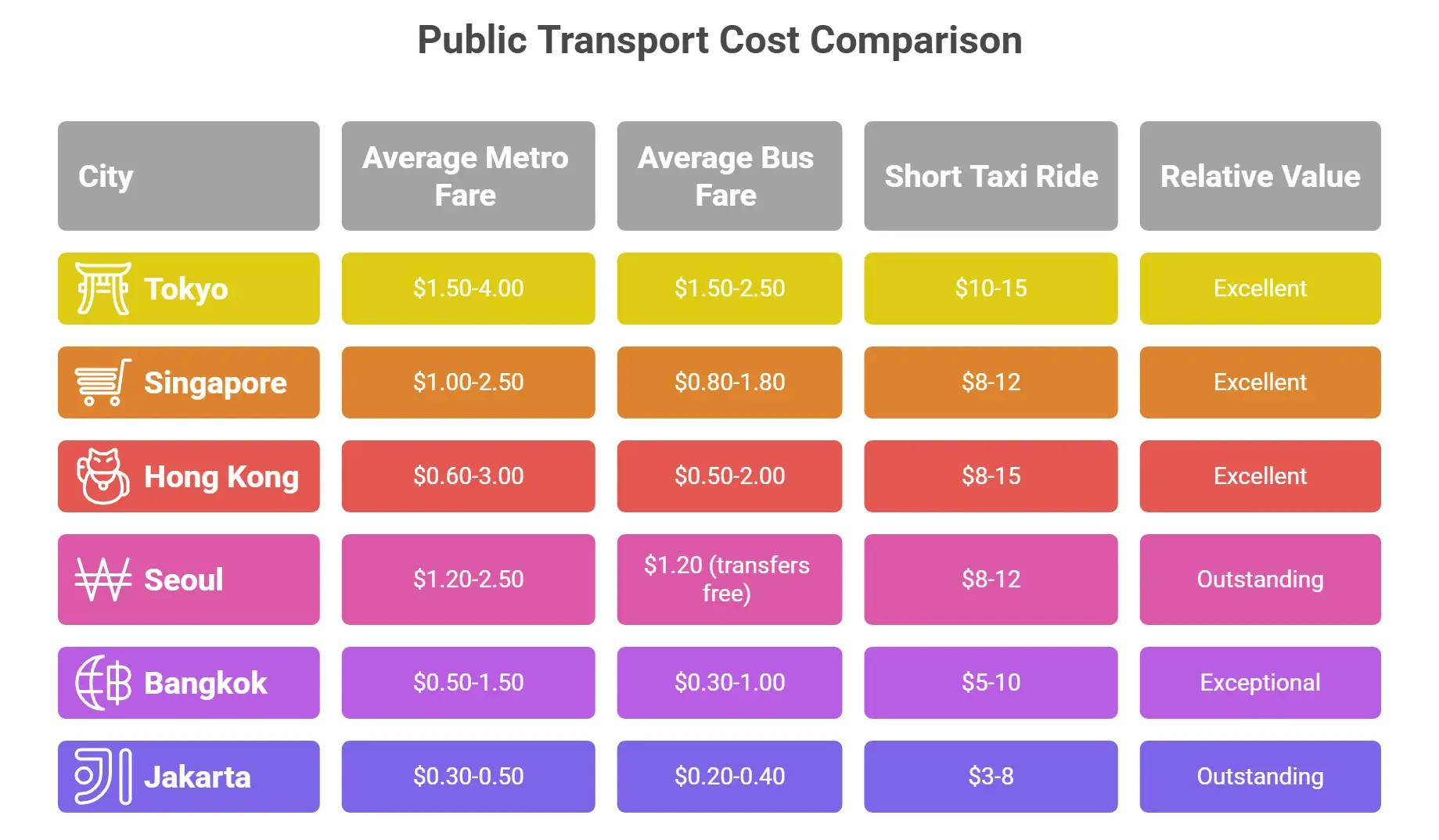
Public transport affordability in major Asian cities makes New York and London look like highway robbery. Bangkok's BTS costs roughly $0.50 to $1.50 per trip. Singapore's MRT averages $1-2. Even Tokyo, one of the pricier systems, rarely exceeds $3-4 for intracity journeys.
Compare that to taxis and ride-hailing? A 10-kilometer taxi ride in Bangkok might run you $8-10, while the same journey on the BTS costs under $2. In Singapore, a CBD taxi ride easily hits $15-20; the MRT covers it for maybe $2.50.
The real comparison though? Time. During rush hour, that $8 taxi sits in traffic for 45 minutes. The $2 train gets you there in 20. You're not just saving money. You're buying back your life.
The Real Problems Nobody Talks About Enough
Let's get honest about challenges of public transport in rapidly growing Asian cities, because it's not all efficient trains and cheap fares.
Overcrowding during peak hours reaches genuinely uncomfortable levels. Tokyo's famous pushers who literally shove people into train cars? That's not a tourist attraction. That's Tuesday morning. Manila's MRT runs at 400% capacity during rush hour. You're not riding a train. You're becoming intimate with strangers in ways that should require dinner first.
Accessibility for disabled passengers remains inconsistent. Singapore and Tokyo have elevators and tactile guidance everywhere. Bangkok? Maybe half the BTS stations have lifts, and good luck navigating the gaps between platform and train. Jakarta's buses rarely accommodate wheelchairs at all.
Women's safety varies dramatically. Seoul and Tokyo offer women-only carriages during peak hours, which honestly shouldn't be necessary but clearly is. Other cities lag behind. The reality is that harassment happens, and infrastructure solutions remain incomplete.
The informal-formal divide creates gaps. Those crucial paratransit services the tuk-tuks, minibuses, jeepneys operate outside official planning. They're unregulated, unpredictable, and absolutely essential. In Jakarta, the relationship between TransJakarta and informal angkot services resembles peaceful coexistence rather than coordination.
Environmental progress happens unevenly too. While sustainable urban mobility in Asia improves with electric buses in Seoul and Singapore, diesel buses still dominate in Manila and Jakarta. The environmental benefits of public transport in Asian megacities are real but incomplete switching from cars to crowded diesel buses isn't exactly carbon-neutral living.
The Future Is Already Here (In Some Places)
How Asian cities are improving public transport quality offers a glimpse of what's coming globally.
Singapore's testing autonomous buses. Seoul's expanding underground transfer malls so you can shop, eat, and transfer without seeing daylight. Hong Kong's building new metro lines into previously car-dependent areas. Bangkok finally connected the airport to downtown with proper rail.
The real revolution though? Digital integration. Apps now tell you the exact bus location, down to the minute. Mobile payment eliminates language barriers. Real-time crowding data helps you choose less-packed trains.
And here's something I've observed: impact of public transport hubs on local SEO and business foot traffic in Asia has created entirely new urban ecosystems. The shops around major stations aren't accidents they're strategic investments. In Tokyo, station malls generate more revenue than entire suburban shopping districts. Businesses compete fiercely for spots near metro exits because foot traffic is guaranteed.
Your Practical Survival Guide
Want to navigate these systems like you actually live there? Here's what I've learned across dozens of cities:
Download the official transit app before you arrive. Google Maps works, but local apps (Navitime for Tokyo, Citymapper for Hong Kong) know the shortcuts Google misses.
Get that rechargeable card immediately. Yes, immediately. Not after you figure things out. First thing at the airport.
Learn the color codes and numbering systems. They make sense once you understand the logic. Blue lines generally run north-south, green east-west. Station numbers let you count stops without knowing the language.
Peak hours are 7-9 AM and 5-8 PM everywhere. Avoid them if possible. If not, embrace the chaos.
Paratransit services rarely have fixed stops. Wave them down, tell the driver your destination, hop out when close. It's more adventure than transit, which is half the fun.
Station food is underrated. Seriously. Some of my best meals have come from station vendors in Bangkok and Tokyo.
Why This All Matters More Than You Think
Here's the thing about urban transport in Asian megacities: it's not just about getting from A to B efficiently. These systems are actively reshaping how cities work, how people live, and increasingly, how the planet survives.
The public transport mode share in dense Asian cities reaches 60-80% in the best-performing locations. That means fewer cars, less congestion, cleaner air, and actually livable urban cores. Cities that get public transport right become magnets for talent, investment, and innovation.
And for you, the traveler? Mastering these systems transforms how you experience a city. You're not trapped in tourist bubbles or expensive taxis. You're moving with the rhythm of the place, seeing neighborhoods tourists never reach, eating where locals actually eat.
The Bottom Line
Public transport infrastructure in Asia represents the most ambitious experiment in urban mobility in human history. Some cities have achieved near-perfection. Others are fighting through growing pains. All of them are trying things Western cities gave up on decades ago.
Is it perfect? Hell no. Crowded, sometimes confusing, occasionally frustrating? Absolutely.
But here's what I know: I've explored Tokyo's hidden neighborhoods, eaten street food in Bangkok's suburbs, and discovered Seoul's coolest cafes, all because I learned to trust the trains and buses.
The metro maps that once looked like incomprehensible spider webs now feel like treasure maps. Those color-coded bus routes? They're shortcuts to authentic experiences you'd never find in a guidebook.
So yeah, Asia's public transport systems might intimidate you at first. But lean into that discomfort. Download the apps. Buy the card. Board the train. The city will reveal itself in ways no taxi tour ever could.
And when you're finally navigating rush hour like a local, seamlessly transferring between metro and bus and paratransit without thinking twice? That's when you'll understand: you haven't just learned a transport system.
You've unlocked an entire continent. Good Luck.
Share this article