
Pekoe Trail Sri Lanka - Complete Hiking Guide

 https://images.prismic.io/natouris/aYsmtt0YXLCxVpfd_PekoetrailsrilankacompletehikingguideThumbnail.webp?auto=format,compress&rect=0,17,1000,525&w=1200&h=630
The Pekoe Trail Sri Lanka is the island's first long-distance hiking trail, stretching 300 kilometers through the Central Highlands tea plantations. This Kandy to Nuwara Eliya trek features 22 stages ranging from easy day hikes to challenging mountain passes. Whether you're searching for Pekoe Trail guided tours, planning a solo adventure, or need details on trail difficulty levels and accommodation options, this complete guide covers permits, best time to hike (December to April), GPS maps, packing essentials, and sustainable tourism tips. Discover why this Sri Lanka hiking trail through working tea estates is becoming South Asia's answer to the Camino.
Let's be honest. You've probably seen Sri Lanka the same way everyone else has: a week bouncing between Sigiriya's monkey-filled fortress, Ella's Instagram-famous Nine Arches Bridge, and a beach in Mirissa where you pretended to care about whale conservation while nursing a hangover.
Here's what you missed: 300 kilometers of the most stunning, under-the-radar hiking trail in South Asia.
The Pekoe Trail isn't just another trek. It's Sri Lanka's first long-distance walking route, a 22-stage journey that winds through the Central Highlands like a thread through the eye of history. Think of it as the Camino de Santiago, but swap the Spanish pilgrims for Tamil tea pluckers, the vineyards for terraced estates, and the spiritual enlightenment for... well, actually, you might find some of that too.
This isn't a trail you stumble onto by accident. It's a deliberate ribbon of footpaths, plantation tracks, and village roads that connects Kandy to Nuwara Eliya, passing through the very estates where Scottish planters first gambled on turning this tropical island into the world's tea garden. You'll walk on 150-year-old bullock cart roads. You'll sleep in colonial-era bungalows (if your budget allows) or bare-bones homestays (if it doesn't). You'll encounter leopards (probably not), leeches (definitely), and some of the warmest hospitality you'll find anywhere.
Ready to trade your resort pool for mud-caked boots? Let's break down everything you need to know.
What Exactly Is the Pekoe Trail?
The Origin Story: More Than Just a Hike
The Pekoe Trail isn't ancient. It officially launched in late 2023, but the paths themselves? They've been here for over a century.
This is the brainchild of Miguel Cunat, a Spanish sustainable tourism consultant who's called Sri Lanka home for two decades. After COVID-19 gutted the island's economy, Cunat partnered with the European Union and USAID to create what he calls a "resilience project." The goal wasn't just to give tourists another checkbox experience. It was to funnel money into rural communities that had been invisible to mainstream tourism for generations.
Ten years of research went into mapping this network. The trail doesn't carve through virgin wilderness. Instead, it stitches together existing footpaths, estate roads, and village tracks, creating a continuous route through the central highlands. It's managed by the Pekoe Trail Organization (TPTO), a nonprofit that reinvests every rupee from trail passes back into maintenance and community programs.
Walking Through History (Literally)
Here's where it gets interesting. This isn't just a nature walk. It's a time machine.
The Pekoe Trail traces the skeleton of the 19th-century tea empire. You'll follow the same routes British planters used to transport tea chests by bullock cart and horse. Stage 2 takes you past the Loolecondera Estate, where James Taylor, a Scottish planter, planted Sri Lanka's first tea crop in the 1860s. His cottage still stands. You can visit it.
Later, at Stage 13, you'll climb to Lipton's Seat, the viewpoint where Sir Thomas Lipton (yes, that Lipton) surveyed his tea kingdom. On clear days, you can supposedly see the southern coast from here. On misty days, you'll see nothing but clouds and regret your lack of waterproofs.
The trail also preserves colonial engineering feats. The Demodara Loop (Stage 16) is a spiral railway line designed to handle brutal elevation changes. The Devil's Staircase (Stage 11) is a knee-destroying descent supposedly named by homesick Scots after a similar hellscape in the Highlands.
The Human Element
Here's what the guidebooks won't tell you: the trail is alive. You're not walking through a museum. You're walking through people's backyards, workplaces, and villages.
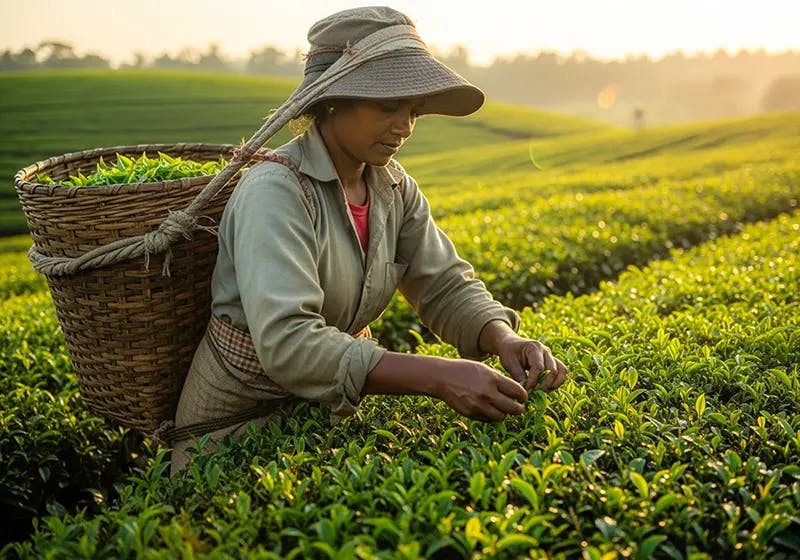
Most of the people you'll meet are descendants of Tamil laborers brought from India by British planters. They live in "line rooms," the barrack-style housing built for workers over a century ago. You'll see women in bright saris plucking tea, two leaves and a bud at a time, the same way their grandmothers did. You'll pass Hindu temples, Christian churches, and Buddhist shrines, often within a few kilometers of each other.
This isn't poverty tourism. This is a chance to see the real engine of Sri Lanka's tea industry, the people who make your morning cup possible, and to support them directly through the trail economy.
By the Numbers: Distance, Stages, and Difficulty
The Full Picture
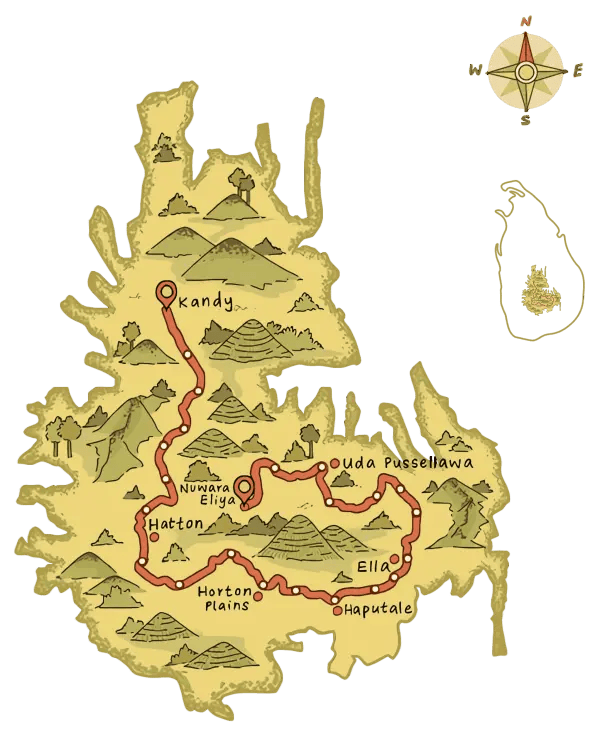
The Pekoe Trail stretches roughly 300 kilometers (186 miles), divided into 22 curated stages. Each stage is designed to be hiked in a single day, ranging from a breezy 9km stroll to a punishing 21km slog.
Here's the breakdown:
| Stage | Route | Distance | Difficulty |
|---|---|---|---|
| 1 | Hanthana to Galaha | 12.8 km | Easy |
| 2 | Galaha to Loolkandura | 14.7 km | Difficult |
| 3 | Loolkandura to Thawalanthenna | 18.1 km | Difficult |
| 4 | Thawalanthenna to Pundaluoya | 15.5 km | Difficult |
| 5 | Pundaluoya to Watagoda | 14.3 km | Moderate |
| 6 | Watagoda to Kotagala | 14.9 km | Moderate |
| 7 | Kotagala to Norwood | 16.5 km | Moderate |
| 8 | Norwood to Bogawantalawa | 15.9 km | Moderate |
| 9 | Bogawantalawa to Dayagama | 17.1 km | Difficult |
| 10 | Dayagama to Horton Plains | 14.9 km | Difficult |
| 11 | Horton Plains to Udaweriya | 14.3 km | Difficult |
| 12 | Udaweriya to Haputale | 19.7 km | Difficult |
| 13 | Haputale to St. Catherine | 14.6 km | Moderate |
| 14 | St. Catherine to Makulella | 9.4 km | Moderate |
| 15 | Makulella to Ella | 9.6 km | Moderate |
| 16 | Ella to Demodara | 9.5 km | Easy |
| 17 | Demodara to Hali Ela | 13.1 km | Moderate |
| 18 | Hali Ela to Ettampitiya | 14.7 km | Difficult |
| 19 | Ettampitiya to Lunuwatte | 21.0 km | Difficult |
| 20 | Lunuwatte to Uda Pussellawa | 13.6 km | Moderate |
| 21 | Uda Pussellawa to Kandapola | 16.9 km | Difficult |
| 22 | Kandapola to Pedro Estate | 11.3 km | Easy |
Who's This For?
The beauty of the Pekoe Trail is its flexibility. You don't need to be an ultramarathon runner, but you can't be allergic to sweat either.
Thru-hikers can complete the full route in 16 to 22 days, depending on pace and rest days. Weekend warriors can cherry-pick the most scenic stages (we'll get to those). Couples looking for something more meaningful than a beach resort will find this infinitely more memorable. Solo female hikers report feeling safe, though the usual precautions apply (we'll cover safety later).
The trail is described as "a hike for everyone," but don't let that fool you. Some stages gain 1,000 meters in elevation. Mud is a constant. Weather changes faster than a tuk-tuk driver's price quote.
The Tough Ones
Let's talk difficulty honestly. Most stages fall into the "moderate" category, meaning you need decent fitness but no technical climbing skills. But several stages will test you:
- Stages 9 and 10 (Bogawantalawa to Horton Plains): Remote, high-altitude, and logistically challenging. Stage 10 ends inside Horton Plains National Park, where there's no accommodation. You'll need to arrange transport or hike Stages 10 and 11 back-to-back.
- The Devil's Staircase (Stage 11): A steep, knee-punishing descent that earned its name for good reason.
- Jacob's Ladder (Stage 9): A rocky mountain pass that becomes treacherous in rain.
The highest point? 2,170 meters at Horton Plains. Expect thin air, dramatic weather, and views that make the suffering worthwhile.
When to Go: Timing Is Everything
The Golden Window: December to April
If you're only taking one piece of advice from this article, make it this: hike between December and April.
January and February are the crown jewels. You'll get dry paths, blue skies, and visibility that stretches to the coast on clear days. This is especially critical for high-altitude sections like Horton Plains, which spends most of the year wrapped in clouds so thick you can't see your own boots.
Nights get cold. We're talking 9°C (48°F) in the highlands. Pack layers.
The Secondary Window: July to September
If you can't swing the December-April window, July to September offers a decent consolation prize. You'll still get good weather, though intermittent showers are possible.
The Wet Season: May to November (For Masochists Only)
Hiking during the wet season isn't impossible, but it requires a different mindset.
The challenges: Mud. Leeches. Slippery rocks. The trail becomes a slip-and-slide through cloud forests, and the leeches emerge like tiny vampires with trust funds.
The strategy: Start early. Rain typically holds off until 2-3pm, so if you begin at dawn, you can finish before the deluge. Mornings can actually be stunning, with mist rolling through the valleys like something out of a nature documentary.
The upside: Fewer tourists. Lush, emerald-green landscapes. Cheaper accommodation. And if you're into the whole "suffer for the views" ethos, this is your season.
Weather Wildcards
Climate change has made weather patterns less predictable. January 2025 saw abnormal rainfall despite being "peak dry season." Always check local forecasts and pack rain gear regardless of when you go.
The tropical sun is brutal even in the cool hills. Dehydration is real. Carry 1.5-2 liters of water per day, minimum.
Packing Like a Pro: The Essential Kit

Footwear: Don't Skimp Here
You need trail runners or hiking boots with aggressive grip. The terrain shifts from smooth tea estate paths to muddy forest tracks to rocky mountain passes. Wet roots are basically ice rinks. Your ankles will thank you for the support.
The Leech Defense
Let's address the elephant in the room: leeches.
During the wet season, or in damp forest sections any time of year, these bloodsuckers are unavoidable. They don't hurt. They're just deeply unpleasant.
Your defense: leech socks (knee-high compression socks that leeches can't penetrate) and long, lightweight trousers. Some hikers swear by salt or tobacco paste rubbed on boots. Others just accept their fate and check their legs every hour.
Clothing Strategy
- Long trousers: Protection from sun, briars, leeches, and judgmental estate workers who frown on shorts.
- Rain jacket: Non-negotiable. Weather changes in minutes.
- Warm layer: Evenings at altitude get cold fast. A fleece or down jacket isn't overkill.
- Hat and sunscreen: The tropical sun doesn't care that you're at 2,000 meters.
The Tech Kit
- Offline maps: Download the Pekoe Trail App, AllTrails, or Wikiloc tracks before you go. Cell service is spotty.
- Power bank: Your phone is your lifeline for navigation. Keep it charged.
- Trekking poles: Useful for stability, river crossings, and keeping aggressive village dogs at a respectful distance.
First Aid Essentials
- Plasters for blisters
- Painkillers (ibuprofen is your friend)
- Antihistamines for bug bites
- Water purification tablets or a filter
Where to Sleep: From Homestays to Colonial Luxury
The Accommodation Spectrum
The Pekoe Trail offers something for every budget, from $8 crash pads to $200 heritage bungalows.
Budget Guesthouses and Homestays ($8-$20/night): These are the backbone of the trail. Expect basic rooms, shared bathrooms, and home-cooked Sri Lankan meals that will ruin you for any other rice and curry. Owners are often estate families eager to practice English and share stories. Recommended spots include Kithul Cabins (Stage 5) and Acacia Inn (Stage 11).
Boutique Estates ($50-$100/night): Amba Estate (near Stages 14/15) is a working organic tea farm where you can learn about artisanal production while sipping your breakfast tea.
Luxury Tea Bungalows ($150-$300/night): For those who want to hike hard and sleep harder. The Heritance Tea Factory Hotel (Stage 21) is a repurposed factory named one of the best places to stay in the world. Teardrop Hotels operates several high-end bungalows like Camellia Hills and Goatfell along the route.
The Hub Strategy vs. Point-to-Point
You don't have to move hotels every night. Many hikers base themselves in key towns and tuk-tuk to trailheads:
- Kandy/Galaha: Base for Stages 1-2
- Hatton/Norwood: Base for Stages 6-8
- Haputale/Ella: These tourist hubs have abundant accommodation and cover Stages 12-16
The Horton Plains Problem
Here's the logistical nightmare: Stage 10 ends inside Horton Plains National Park. There's no accommodation. No tuk-tuks waiting. Just you, the wilderness, and a very expensive pick-up you need to arrange in advance.
Most hikers stay at Rohitha Guest in Agarapathana (requires transport from the end of Stage 9), then arrange a drop-off and pick-up for Stage 10. Alternatively, hike Stages 10 and 11 continuously to reach Ohiya, though this is a brutal 28km day.
Booking Tips
- Popular hubs (Ella, Haputale, Nuwara Eliya): You can often find rooms last-minute.
- Remote villages (Deltota, Loolkandura, Ohiya): Book ahead or call before arrival.
- Peak season (December-April): Popular guesthouses fill fast.
Getting There: Transport and Access Points
The Railway Romance
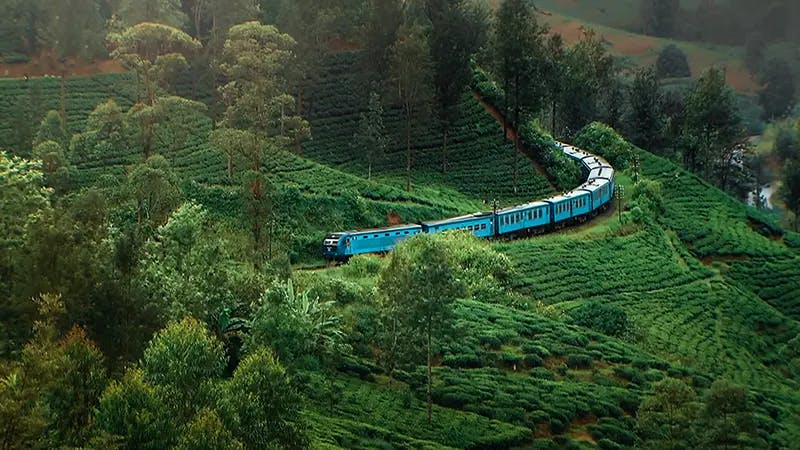
One of the Pekoe Trail's best features? It intersects frequently with Sri Lanka's Main Line railway, one of the most scenic train routes in the world.
Key stations along the trail include Watagoda (Stage 5), Kotagala (Stage 6), Ohiya (Stage 11), Haputale (Stage 12), Ella (Stage 15), and Demodara (Stage 16). You can hop on and off the trail using trains, though timetables are more "suggestions" than strict schedules.
The Tuk-Tuk Advantage
Three-wheelers are your best friend on this trail. They're cheap, ubiquitous, and can navigate narrow estate roads that buses can't.
Pro tip: Use tuk-tuks for luggage transfer. Hike with a light daypack and pay a driver to deliver your heavy bags to your next accommodation. This costs $10-$20 depending on distance and your haggling skills.
Emergency bail-out: If you're tired, lost, or running out of daylight, you can almost always find a tuk-tuk in a nearby village to rescue you.
Starting in Kandy
The official trailhead is the Ceylon Tea Museum in Hanthana, about 5km from Kandy city center. There are no public buses. Book an Uber, PickMe (Sri Lanka's local ride-hailing app), or taxi.
Finishing in Nuwara Eliya
The trail ends at Pedro Estate, just 3km from Nuwara Eliya town. Easy tuk-tuk or bus access to celebrate your finish with a beer at the Grand Hotel, a crumbling colonial relic that feels frozen in 1930.
Safety, Permits, and What Could Go Wrong
The Trail Pass System
As of 2024, the Pekoe Trail requires a Trail Pass: approximately $10 per stage or a membership for unlimited access. This isn't a cash grab. Revenue funds trail maintenance, environmental protection, and community programs.
Purchase through the official Pekoe Trail website.
National Park Fees
Stage 10 (Horton Plains) requires a separate National Park ticket (approximately $45 USD). This must be purchased before entering and is strictly enforced. There's also a small fee for Lipton's Seat (Stage 13).
The Leech Reality Check
We've mentioned them, but let's be clear: leeches don't transmit disease. They don't hurt. They're just psychologically disturbing. You'll pull them off, they'll leave small blood stains on your socks, and you'll move on with your life.
Salt or tobacco paste on boots helps. Leech socks are better. Acceptance is best.
Village Dogs
You will encounter territorial dogs. They bark aggressively but rarely bite. Trekking poles are excellent for keeping them at a respectful distance. Don't run. Don't make sudden movements. Walk confidently and they'll usually back off.
The Leopard Question
Leopards exist in the highlands, particularly in conservation corridors around Stages 8, 9, and 10 (Horton Plains). Attacks on hikers are virtually unheard of.
The advice: Avoid hiking at dawn or dusk in these specific areas. Make noise. Don't hike alone if you're genuinely worried. The odds of seeing one are low. The odds of being attacked are astronomically lower.
Terrain Hazards
- Mud: Inevitable in rain. Take your time on descents.
- Overgrown vegetation: Some sections are poorly maintained. Long trousers and patience required.
- River crossings: A few stages involve hopping across streams. Wet rocks are slippery.
Weather Hazards
- Dehydration: Even in cool weather. Carry enough water.
- Hypothermia: Rare but possible at high altitude if you're wet and cold. Pack warm layers.
- Lightning: If storms roll in at altitude, seek shelter immediately.
Responsible Tourism: Don't Be That Tourist
The No Candy Rule
You will encounter children asking for "bonbons" (candy), pens, or money. Do not give anything.
Why? It encourages dependency and begging. It motivates kids to skip school and wait for hikers instead. If you want to help, donate to verified TPTO community projects or local schools directly.
Support the Local Economy
- Buy from village shops (kades): Water, coconuts, snacks. Put cash in local hands.
- Hire local guides: TPTO-certified guides provide income to estate families and cultural insights you'd otherwise miss.
- Choose homestays: Keep tourism dollars in the community, not corporate hotel chains.
Respect the Working Landscape
This isn't a national park. It's people's livelihoods. Don't photograph workers without permission. Stay on marked paths. Don't damage tea bushes or crops.
Leave No Trace
Carry all trash out. Waste management is limited in rural areas. If you pack it in, pack it out.
Environmental Sensitivity
Stages 8, 9, and 10 pass through leopard conservation corridors and cloud forests. Stick to trails. No wild camping (it's prohibited on private plantation land anyway).
FAQ: Everything Else You're Wondering
What is the Pekoe Trail?
Sri Lanka's first long-distance hiking route, a 300km trail through the Central Highlands connecting Kandy to Nuwara Eliya via 22 stages through tea estates, cloud forests, and rural villages.
Where does the Pekoe Trail start and end?
Starts at the Ceylon Tea Museum in Hanthana (near Kandy) and ends at Pedro Estate (near Nuwara Eliya). Can be hiked in either direction or in non-sequential segments.
How long is the Pekoe Trail and how many stages does it have?
Approximately 300km divided into 22 stages, ranging from 9km to 21km each.
What is the best time to hike the Pekoe Trail?
December to April (especially January and February) for dry paths and clear views. July to September is a secondary window. May to November is wet season (mud, leeches, afternoon rain).
Do I need a guide for the Pekoe Trail?
No, but it's recommended. The trail is self-guided with waymarking and offline maps, but local guides enrich the experience with cultural context and support the local economy.
How do I get to the trailheads?
Tuk-tuks, trains (Main Line railway intersects frequently), and buses. Kandy is accessible by bus or train from Colombo. Nuwara Eliya has good bus connections.
Is the trail marked, and do I need maps or GPS?
Waymarking exists but can be inconsistent. Download offline maps via the Pekoe Trail App, AllTrails, or Wikiloc before you go. Cell service is unreliable.
How long does it take to complete the full trail?
16 to 22 days for thru-hikers, depending on pace and rest days.
What about accommodation and camping along the trail?
Budget guesthouses ($8-$20), boutique estates ($50-$100), and luxury tea bungalows ($150-$300). Wild camping is generally prohibited. Some stages (like Stage 10 at Horton Plains) require logistical planning for accommodation.
Is there a fee or pass required to hike?
Yes. Trail Pass costs approximately $10 per stage or purchase a membership for unlimited access. Stage 10 (Horton Plains) requires a separate National Park fee (~$45).
Can I hike individual stages only?
Absolutely. The trail is designed for flexibility. Cherry-pick stages based on location, fitness level, and available time.
What should I pack or watch out for (leeches, water, etc.)?
Sturdy boots, long trousers, leech socks, rain jacket, warm layer, trekking poles, offline maps, power bank, water (1.5-2 liters/day), and basic first aid. Watch for leeches (wet season), village dogs, mud, and sudden weather changes.
The Bottom Line: Why This Trail Matters
The Pekoe Trail isn't just a hiking route. It's a statement about what tourism can be when it's done right.
Instead of funneling travelers through the same overcrowded circuits, it creates economic opportunities in villages that have been invisible for generations. Instead of extracting value from rural communities, it reinvests profits into trail maintenance and environmental protection. Instead of reducing Sri Lanka to beaches and temples, it reveals the living heritage of the tea industry and the people who sustain it.
You'll finish this trail with muddy boots, leech-bite scars, and a perspective on Sri Lanka that 99% of tourists never get. You'll also contribute directly to the resilience of communities that need it most.
So here's the question: are you content with another week at a beach resort, or are you ready to actually see the island?
Read Our Pekoe Trail Article Series:
- Pekoe Trail Stage 1
- Pekoe Trail Stage 2
- Pekoe Trail Stage 3
- Pekoe Trail Stage 4
- Pekoe Trail Stage 5
- Pekoe Trail Stage 6
- Pekoe Trail Stage 7
Related Reading:
- Ceylon Tea Plantation Tours: A Complete Guide
- 20 Things to Do in Kandy, Sri Lanka
- Best Time to Visit Sri Lanka: Monthly Guide
Official Organization: Thepekoetrail.org
Pack smart. Walk slow.
Share this article